
Window repair vs. replacement: what to know before you sign a quote
If a window company has told you your old wood windows "need" to go, this page is the second opinion. It covers what each option costs, how long each lasts, what the energy research says, and the handful of cases where replacement really is the right call.
At a glance
| Repair the original | Replace with new units | |
|---|---|---|
| Typical cost per window | A fraction of replacement — most sash, cord and glazing repairs come in well under the cheapest vinyl unit. Mark quotes after seeing the window. | About $800–$1,600 installed for vinyl; $1,100–$2,200+ for wood or fiberglass; premium full-service brands higher. Surveyed homeowners average roughly $7,000 per project.1, 2 |
| Expected life | The window has already lasted 80–130 years. Repaired and maintained, it keeps going — every part can be serviced again. | Generally a couple of decades. Sealed glass units can fog when the seal fails, and the fix is another replacement. |
| Energy performance | Weather-tight sash plus an exterior storm panel performs within the range of a new replacement window, per the National Trust's study.3 | Good when new. Payback on energy savings alone is long because the upfront cost is high. |
| Materials | Old-growth wood: dense, stable, rot-resistant, holds paint. Wavy original glass. | Vinyl, fiberglass or new-growth wood. Flat float glass. |
| Your home's character | Unchanged. Trim, sills, proportions and divided lights all stay. | Thicker frames shrink the glass area; interior and exterior trim are often disturbed or replaced. |
| Disruption | Usually a few hours per window, from inside. No tear-out. | Tear-out, possible siding/plaster patching, a dumpster, and a crew for a day or more. |
| Landfill | Nothing goes to the landfill. New cord, putty and paint. | Every old window out; every new one eventually follows it. |
Costs are national 2026 installed-price ranges from manufacturer and contractor guides; Cincinnati quotes vary. See sources.
What a replacement quote usually doesn't mention
Your windows were built to be serviced. An original double-hung is a kit of parts: cords, weights, pulleys, glazing, hardware. When one part wears out you replace that part — which is why these windows are still here after a century. A vinyl unit is a sealed appliance; when it fails, it's replaced whole.
Old-growth wood is better wood. Lumber milled before the 1940s came from slow-grown trees: tighter grain, more natural rot resistance, better paint retention than anything sold today. Wood windows made before 1940 are typically old-growth, which is why a 1915 sash in Westwood is usually sounder than a 1995 one.
"Maintenance-free" means "non-repairable." A fogged double-pane unit, a cracked vinyl corner weld, a failed balance spring — none of these are fixable in the field. The sales pitch against wood is that it needs paint; the trade-off nobody states is that vinyl can't be fixed when it fails.
Insert replacements shrink your glass. The common "pocket" replacement slips a new frame inside the old one, so you lose an inch or two of glass on every side and the window looks visibly heavier from the street.
Energy: the honest answer
A drafty, single-pane window with a broken cord and no storm is losing heat. The question is what fixes that most cost-effectively.
The National Trust for Historic Preservation commissioned an engineering study, Saving Windows, Saving Money, that modeled a typical house in five U.S. climates. It found that several retrofits — interior panels, exterior storm windows, and storms combined with cellular shades — achieve energy savings within the range of new high-performance replacement windows, and that almost every retrofit option offered a better return on investment than replacement.3
In plain terms: re-rope and weather-tighten the sash, re-glaze so the glass is sealed in its putty, and keep the storm panels working, and you have most of the comfort of a new window for a small fraction of the price. Air-sealing the attic and basement will do more for your gas bill than either option.
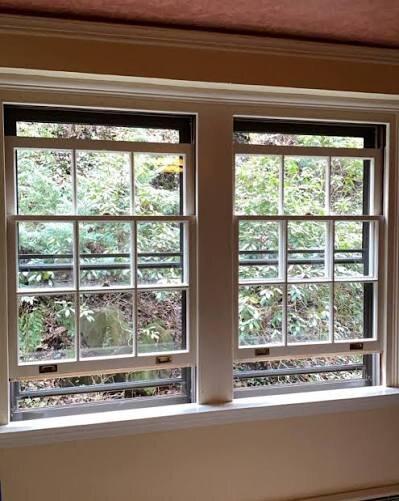
When replacement really is the right call
Mark doesn't sell replacement windows, so he has no stake in the answer. There are honest cases for replacing:
- The frame is rotted through. A soft sill or a rotted lower rail is repairable. A jamb and head that crumble end to end usually aren't worth it.
- They're already cheap replacements. Failed vinyl or aluminum units from the 1980s–2000s can't be restored; Mark doesn't service them (see the FAQ).
- Egress. A bedroom window too small to climb out of may need to be enlarged for safety and code.
- You want a different window. A new size, a picture window where a pair of double-hungs was — that's a remodel, not a repair.
Everything else — stuck, drafty, rattling, painted shut, won't stay open, cracked putty, a broken pane, a storm that doesn't fit — is a repair.
Repair vs. replacement questions
How much does it cost to replace a window in 2026?
Industry guides put professionally installed replacement windows at roughly $800–$1,600 per window for vinyl and $1,100–$2,200 or more for wood or fiberglass, with surveyed homeowners averaging about $7,000 per whole-house project. Premium full-service brands run higher still. A repair to an original window is a fraction of even the low end of those figures.
Are new windows really more energy efficient than my old ones?
A new double-pane unit beats a neglected single-pane window with gaps. But the National Trust for Historic Preservation's study Saving Windows, Saving Money found that a weather-tight original window with a good exterior storm panel falls within the performance range of a new replacement window — at a much lower cost and a better return on investment.
How long do vinyl replacement windows last compared to repaired wood windows?
Vinyl units are generally expected to last a couple of decades, and their sealed glass units can fog once the seal fails — at which point the sash or the whole window is replaced again. The original wood windows in Cincinnati's pre-1950 houses have already lasted 80 to 130 years and, once repaired, can be maintained indefinitely because every part is serviceable.
When should I replace instead of repair?
When the frame itself is rotted through (not just the sill or a corner), when the windows are already low-quality replacements, when a bedroom window can't meet egress requirements, or when you want a different size or style. Mark will tell you honestly if a window is past saving — he doesn't sell replacements, so he has no reason to steer you either way.
Sources
- Pella, Replacement Window Cost in 2026 — installed ranges by material.
- Fixr, Window Installation Cost: A Detailed Breakdown (2026) — homeowner survey averages per window and per project.
- National Trust for Historic Preservation / Preservation Green Lab, Saving Windows, Saving Money: Evaluating the Energy Performance of Window Retrofit and Replacement (2012); summary at savingplaces.org.
Get a second opinion before you replace.
Tell Mark what the windows are doing. If they're worth saving — and they usually are — he'll tell you what it takes.
Call (513) 921-1244